
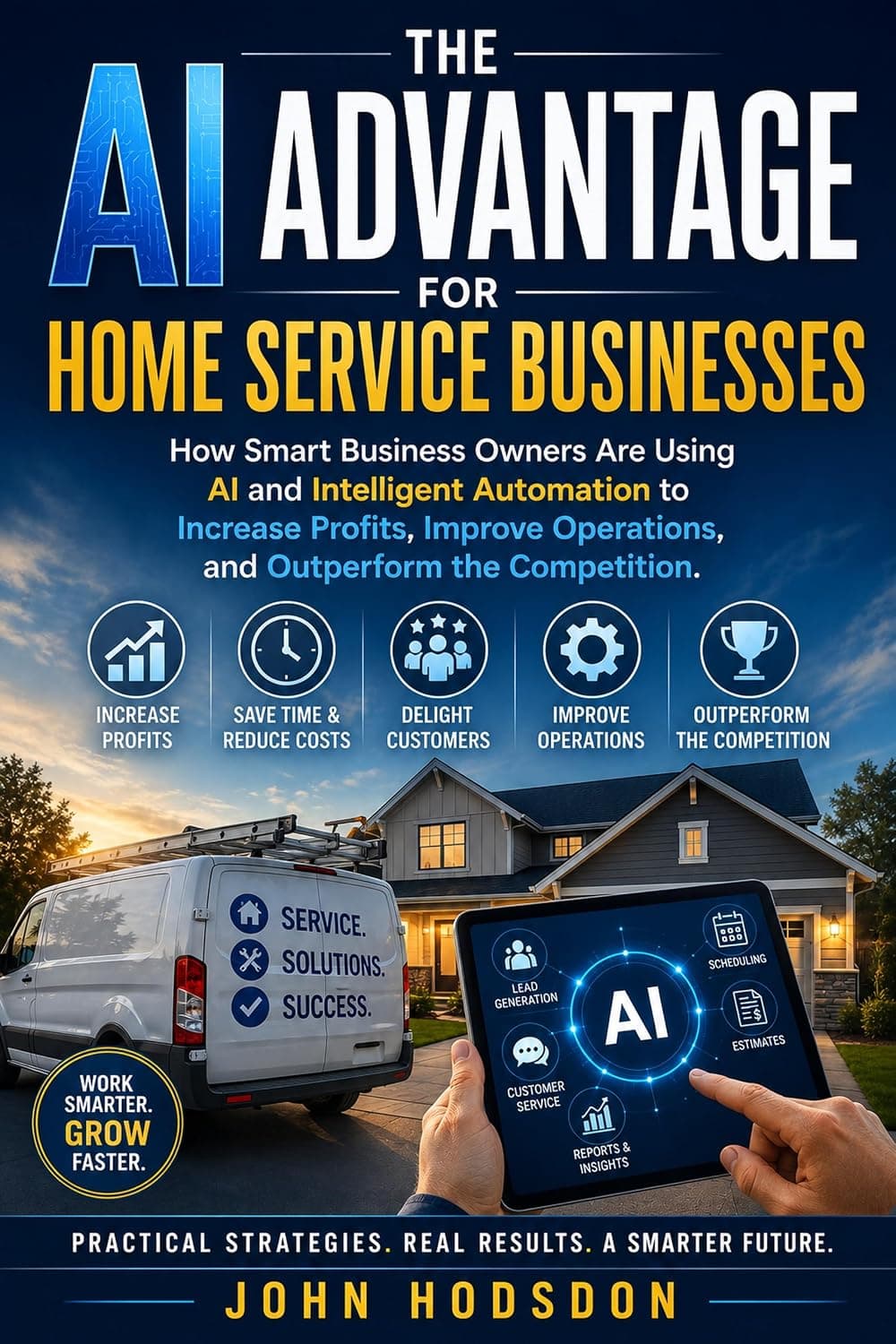
The AI Advantage for Home Service Businesses
A practical playbook for owners of restoration, remodeling, HVAC, plumbing, electrical, roofing, landscaping, and other home service businesses. Written in plain English — not consultant-speak.
By the end of this guide, you will:
- Map your entire business on one page and spot inefficiencies you never knew existed
- Write build-ready specifications that an AI agent can execute correctly on the first try
- Set up a team of specialized AI agents that work 24/7 for $20-50/month total
- Build custom web applications without writing code or hiring developers
- Create a self-documenting, self-improving business system that gets more valuable every quarter

What's Inside
28 chapters across 5 parts. A complete progression from understanding your business to running a self-improving AI system.
Know Your Business
Map your operations, find the leaks, identify constraints
Design What Good Looks Like
Turn findings into build-ready specifications
Stand Up Your Agent Team
Pick, configure, and coordinate specialized AI agents
Build & Automate
Build custom web applications and scheduled automations
Keep Getting Better
Continuous improvement, cost control, compounding advantage
Core Concepts You'll Master
These aren't academic theories. They're the frameworks that have guided real home service businesses to measurable results.
The Four Losses
Time loss, knowledge loss, opportunity loss, and margin loss. Every inefficiency in a home service business falls into one of these buckets. Once you learn to see them, you'll spot them everywhere.
Single vs. Multi-Agent Architecture
Why one ChatGPT window isn't enough — and how a team of specialized agents (each running the right-cost model) saves money while performing better.
Build-Ready Specs
The difference between a wish ("I want an agent that handles invoices") and a specification an agent can execute on the first try. The 17-year-old test.
The SOUL.md Pattern
How to encode your business knowledge — crew names, pricing rules, customer types, edge cases — into agent memory that compounds over time.
Ready to Read the Full Guide?
Download the complete 105-page PDF — free, no email required.
37,000 words. 28 chapters. 5 parts. Everything you need to get started.
Download PDF →